Why I Stopped Being the Queue
One night I listed my open Claude sessions and counted ten. Five were finished. Two were waiting on work that had already been merged in another repo, one was four months old, and two open pull requests fixed the same bug in different places.
Claude could take a clear task and turn it into a pull request in a few minutes, so the sessions themselves weren't slow. Every one of them had stalled at the same point, which was me deciding what came next. I wanted to ship ten times more on my side projects, and that pile of sessions told me where the time was going.
So I sat down with Claude to design a different way of working. We called it Fluid. The agent proposes work on a board, I approve or throw away each proposal, and the agent builds what I approve and leaves a pull request. This post covers the first day: what I asked for, the ideas that didn't survive, and the two boards that did.
The list I started from
Before designing anything I wrote down what I needed:
- Pick up the same work from any device.
- Have the agent propose what's next, and only choose.
- Go from a one-line idea to a real project without a setup ceremony.
- Keep several projects moving at once.
- Pay nothing extra: no new subscriptions and no per-token bills.
- Run it on hardware I control.
- Try every change on a preview before it goes live.
- Write it up so anyone can build their own.
I already had the first one. The rest is what this series is about.
The first version was too simple
My first idea fit in a sentence. Claude suggests features on a board, I tick the ones I like, and Claude builds them. Then the details started pushing back.
The first question was where the board should live. GitHub Issues sits next to the code, but choosing things from a phone is clunky there. I wanted cards I could drag between columns with a thumb, and Trello won mostly because of its phone app.
The second was where the work should run. Scheduled cloud agents were the easy answer, and I dropped them for two reasons. My projects depend on services that only exist on a machine at home. And I didn't want anything that could keep working when I wasn't paying attention, because then nobody is choosing what gets built. A small timer on my own machine now checks the boards every few minutes and starts Claude only when a card has something to do.
The third took the longest. If Claude can propose without a limit, I haven't stopped being the bottleneck, I've just swapped writing tasks for reading them. I settled on three proposals per project. A new one only appears when I approve, freeze or discard one of the three. When I'm busy and decide nothing, the board sits still and costs nothing.
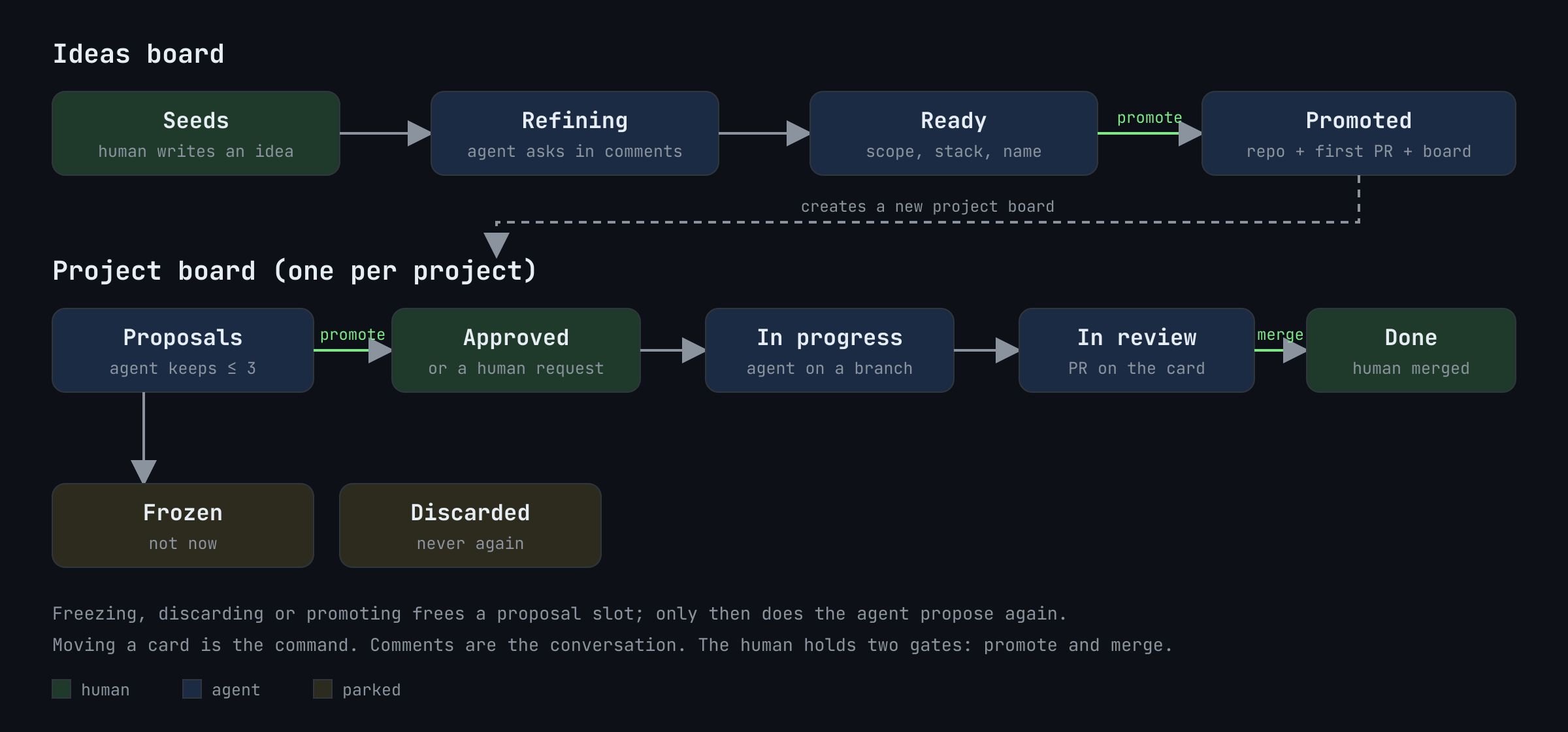
That gave the loop its shape. On an Ideas board I drop a one-line idea, and Claude asks questions in the card's comments until it understands what I mean. If I promote it, it gets a repository and a board of its own. There Claude keeps its three proposals, builds the approved ones, and attaches the pull request to the card. I approve proposals and I merge. The agent never merges.
The free plan said no to my board layout
My plan for several projects was one big board with a label per project. Trello's free plan allows ten open boards per workspace, which ruled that out, and the big board would have been unreadable after three projects anyway.
So the layout changed to one Ideas board plus one board per active project, with idle projects archived. That leaves nine active projects at a time, which is more than I can steer anyway. A limit made the design better, which happens more often than I expect.
Where it stood that evening
By the afternoon Claude had written a small tool that creates the boards. Running it twice doesn't duplicate anything. I spent the day deciding and reviewing, and Claude spent it building.

The board was empty and nothing moved cards yet. I also had no numbers. I never counted features per week before Fluid, so the ten-times goal has no baseline, and the cap of three is a guess I haven't compared with two or five.
Who this is for
The loop helps if an agent already turns your tasks into pull requests faster than you can think of the next one. If you still write most of the code yourself, a board of proposals is one more inbox. It also asks something of you: projects the agent can work on without supervision, a machine to run the timer, and the habit of clearing the three proposals. If you skip that habit, the board fills up and waits.
Next up: the piece that moves cards. A timer that reads the boards, keeps three proposals per project and hands approved cards to Claude.